Note that the three identities above all involve squaring and the number 1You can see the PythagoreanThereom relationship clearly if you consider the unit circle, where the angle is t, the "opposite" side is sin(t) = y, the "adjacent" side is cos(t) = x, and the hypotenuse is 1 We have additional identities related to the functional status of the trig ratiosWe have the function y = sin − 1 ( x 2 1 x 2) For y to be defined x 2 1 x 2 < 1 which is true for all x ∈ R Now, y = sin − 1 ( x 2 1 x 2) ⇒ x 2 1 x 2 = sin If log (√(1 x^2) x) = y√(1 x^2), then show that (1 x^2)dy/dx xy 1 = 0 asked in Mathematics by Samantha ( 3k points) continuity and differntiability
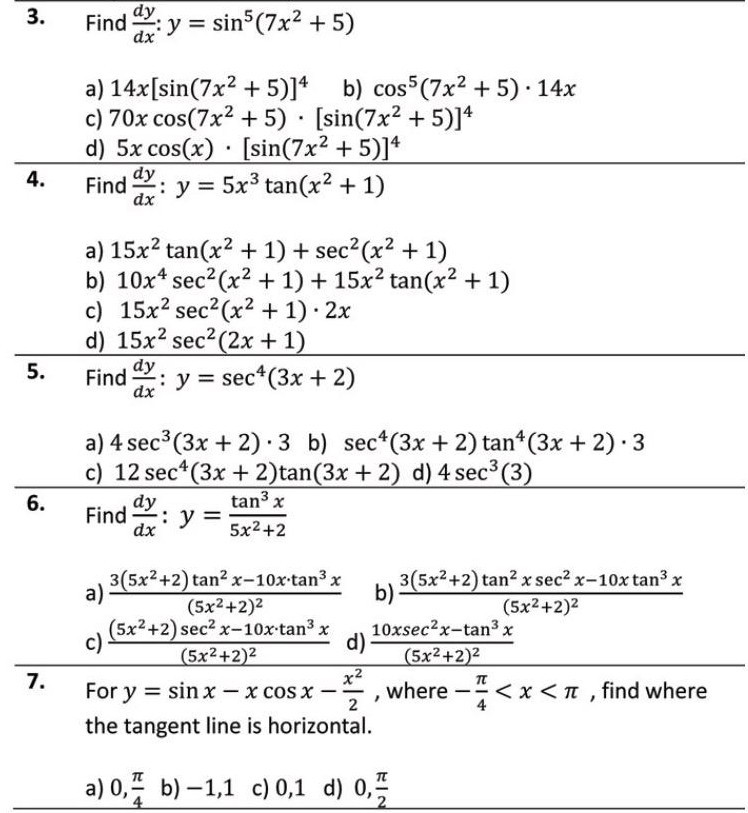
Solved 3 Find Dy Y Sin 7x2 5 A 14x Sin 7x2 5 B Chegg Com

